Gasum enables flexible, low carbon gas distribution across the Nordics with glass fibre composite MEGCs.
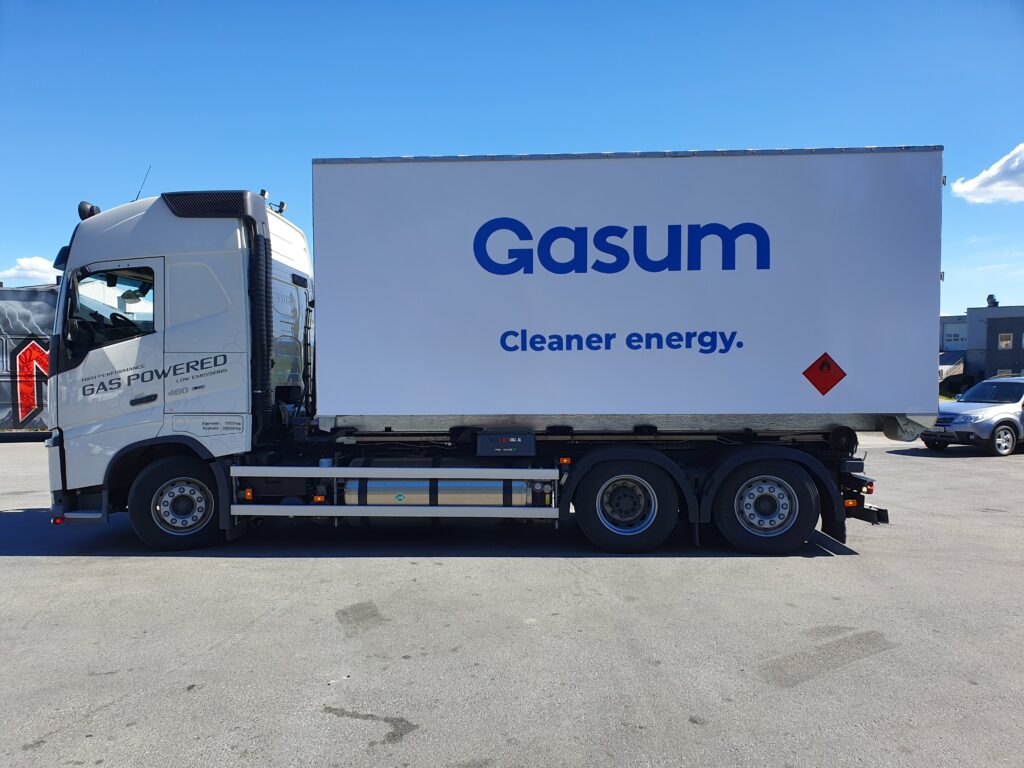
By using glass fibre composite MEGCs from UMOE Advanced Composites (UAC), Gasum supports the efficient transport of compressed biogas and natural gas across Norway, Sweden and Finland. The solution enables Gasum to deliver gas beyond the pipeline network, while balancing safety, regulatory compliance and long‑term operating economics in demanding Nordic conditions.
The challenge of distributed gas transport in the Nordics
Gasum operates across the Nordic gas value chain, producing, sourcing, distributing and selling natural gas and biogas to customers in transport, shipping and industry. While pipelines and liquefaction play an important role, many production sites and end users are not connected to fixed infrastructure.
Several biogas plants do not include liquefaction as part of their process. In these cases, transporting gas in compressed form is the most practical way to supply refuelling stations, industrial customers or onward processing facilities. However, compressed gas transport introduces challenges related to payload efficiency, road weight limits, safety requirements and operating costs.
Although Gasum primarily transports gas within each country, national regulations and road weight limits differ between Norway, Sweden and Finland. Any transport solution must therefore comply with local requirements while remaining robust and safe in daily operation.
About Gasum
Gasum is a Nordic energy company focused on cleaner energy solutions. The company has 19 biogas plants in Sweden, Finland and Denmark which convert approximately one million tons of municipal and agricultural waste each year into biogas and renewable fertilizer and nutrients. Liquified and compressed biogas, natural gas and LNG are supplied to customers in transport, shipping and industry across the Nordics. Gasum also operates gas refuelling stations and manages a large logistics fleet to ensure reliable gas delivery across the region.
Sustainability is central to Gasum’s business model. By converting organic municipal and agricultural waste into biogas, Gasum captures methane that would otherwise be emitted during decomposition and puts it to productive use as a transport fuel or energy source, reducing emissions across multiple sectors.
The decision: payload, safety and lifecycle cost
When selecting gas transport equipment, Gasum evaluates both CAPEX, OPEX and Total Cost of Ownership (TCO). Traditional steel cylinders have historically been widely used, but their lower payload efficiency and limited gas capacity can significantly increase transport costs per unit of energy delivered.
Over time, Gasum has introduced glass fibre composite MEGCs alongside legacy steel cylinders. In daily operation, the lighter composite solution has proven better suited to frequent transport cycles, enabling higher payloads within Nordic road weight limits and reducing cost per trip.
Because road weight limits differ between Norway, Sweden and Finland, UMOE Advanced Composites has configured MEGCs with different numbers of cylinders to ensure compliance in each country. This approach allows Gasum to operate efficiently in each market while maintaining consistent safety and performance standards.
Why Gasum chose glass fibre composite MEGCs
Gasum has extensive experience operating both steel and composite gas transport solutions. Glass fibre composite MEGCs have demonstrated clear advantages compared to traditional steel solutions:
- Higher usable gas payload within national road weight limits, improving transport efficiency
- Lower operating and lifecycle costs, including reduced inspection and maintenance requirements
- Robust performance in demanding Nordic climates
- Proven safety performance in long‑term, daily operation
For Gasum, these characteristics make glass fibre composite MEGCs a practical and scalable solution for large‑scale gas distribution.
The UMOE Advanced Composites solution
UAC supplies Gasum with customized glass fibre composite MEGCs adapted to national regulations in Norway, Sweden and Finland. While the cylinders themselves remain unchanged, container configurations and cylinder counts are adjusted to meet local road weight requirements.
Gasum operates a large fleet of UAC MEGCs alongside legacy equipment, using them for domestic transport and limited cross‑border flows where required. The MEGC concept enables Gasum to move compressed gas efficiently to refuelling stations, industrial customers and, in some cases, onward processing facilities.
Operational performance and reapproval
Operational reliability, safety and regulatory compliance are critical for Gasum. All MEGCs, including composite units, are subject to mandatory reapproval after five years of operation.
The reapproval process requires selected containers to be taken out of service and fully disassembled. Cylinders undergo hydraulic pressure testing, drying and nitrogen leak testing, with results compared against baseline data from new cylinders to verify continued integrity and performance.
UAC worked closely with Gasum throughout this process, providing technical support, documentation and coordination to ensure that reapproval was carried out efficiently and in full compliance with applicable regulations. This collaboration has ensured that Gasum can continue operating its fleet with confidence over the intended lifetime of the equipment.

“The reapproval work was a very good collaboration and important for us as a fleet operator.”
Ingrid Strømdal, Service Manager, Gasum.
Working with UMOE Advanced Composites
In addition to the equipment itself, Gasum highlights the value of close technical cooperation. UAC supports Gasum with engineering input, regulatory understanding and responsive communication throughout the lifecycle of the equipment.
“It’s easy to get in touch with the right people, and the technical dialogue is always constructive. That makes day‑to‑day cooperation straightforward.”
Ingrid Strømdal, Service Manager, Gasum.
Supporting the energy transition
For Gasum, compressed gas transport using MEGCs enables a flexible “virtual pipeline”, allowing biogas to be delivered to customers beyond fixed infrastructure.
The long‑term collaboration with UAC demonstrates how glass fibre composite MEGCs can support practical, scalable gas distribution in regions where flexibility, safety and cost efficiency are essential.