MIMU Tank Leasing builds a safe and flexible renewables fleet with glass fibre composite MEGCs.
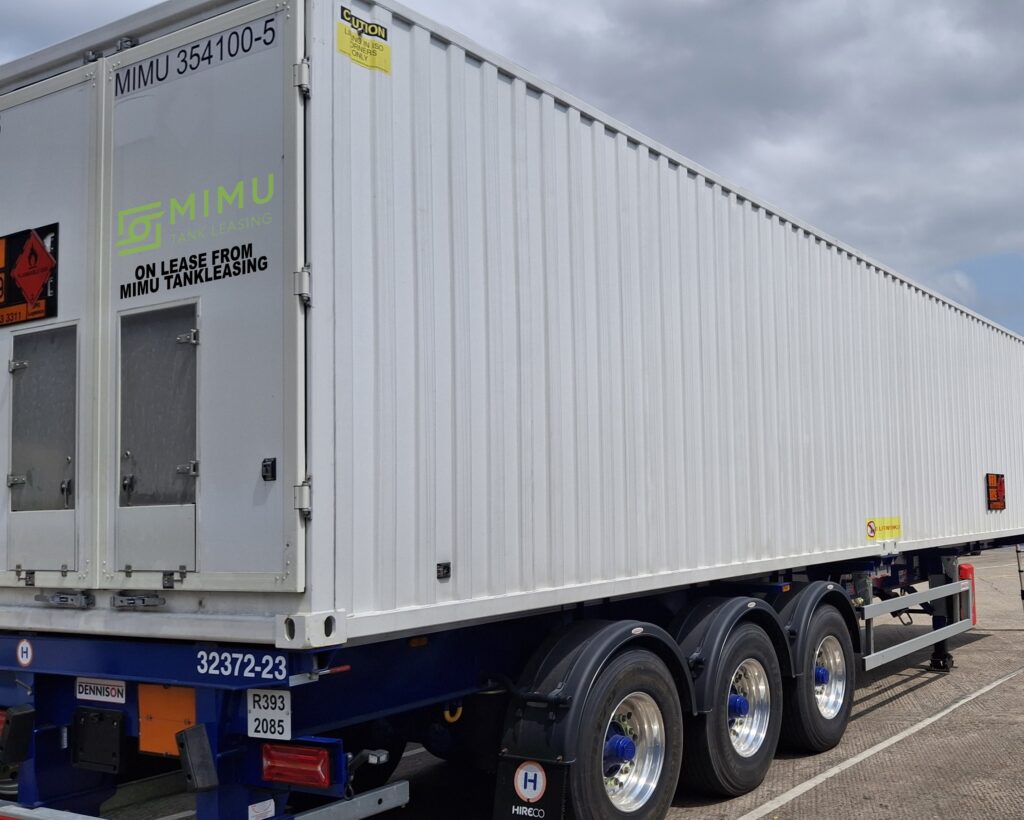
By choosing glass fibre composite Multi-Element Gas Containers (MEGCs) from UMOE Advanced Composites, MIMU Tank Leasing is enabling efficient regional transport of hydrogen and CNG, balancing safety, robustness and cost. The result is a fleet designed for smooth operations, long asset life and flexible leasing.
The challenge of regional hydrogen and CNG transport
As hydrogen began moving from pilot projects toward early commercial deployment, MIMU saw growing demand for transport solutions suited to regional and last‑mile distribution. These applications typically involve short to medium distances, frequent loading cycles and multiple operators. These conditions place high demands on safety, durability and operational simplicity.
For many customers, the challenge was finding an MEGC that is safe, reliable and economically sound for everyday use, rather than maximizing payload at any cost.
About MIMU Tank Leasing
MIMU Tank Leasing is a family‑owned ISO tank container leasing company with a clear focus on specialty equipment. After starting out as a third‑party logistics provider, the company made a strategic shift to focus solely on leasing, allowing it to build and manage a long‑term fleet rather than operate assets itself.
MIMU serves customers across several industries, including chemicals, food products and compressed gases. To support emerging energy markets, the company established a dedicated renewables department focused on hydrogen, CNG, biogas, ammonia and methanol. Because MIMU retains ownership of its units, long‑term safety, robustness and residual value are central to every investment decision.
The decision: balancing safety, robustness and cost
Introducing MEGCs into a leasing fleet raised several key considerations for MIMU. Safety was non‑negotiable, particularly when working with hydrogen and other compressed gases.
MIMU also needed a solution that made commercial sense for typical delivery patterns and real day‑to‑day operating requirements. Many hydrogen routes involve distances of 50–150 kilometres, often with multiple delivery rounds per day. In these scenarios, the priority is achieving the right balance between capital and operating costs, payload, lifetime, and robustness.
Why MIMU chose glass fibre composite MEGCs
MIMU evaluated different MEGC concepts and materials, including traditional steel solutions and carbon fibre composite designs. For regional hydrogen and CNG transport, MIMU found that glass fibre technology aligned best with actual utilization patterns and lifecycle economics, ensuring the solution matched how the equipment is used in practice:
- Higher payload and lower operational costs compared to Type 1 steel solutions
- Lower capital cost and a more robust safety than carbon‑fibre‑based alternatives
- Well suited to frequent loading cycles
For MIMU and its customers, this balance translated into practical value: reliable daily operations with a highly competitive total cost of ownership (TCO).
The UMOE Advanced Composites solution
UMOE Advanced Composites supplied MIMU with glass fibre composite Type IV MEGCs for hydrogen and CNG applications. At the time of publication, MIMU had six UAC MEGCs in its fleet: three 20‑foot units and three 40‑foot units which are currently deployed in the UK.
UAC is involved early in customer projects, supporting technical definition, configuration and documentation. This ensures that each unit meets both customer requirements and MIMU’s own standards for safety and long‑term fleet value.
Operational performance in daily use
One of the key advantages of UAC’s solution is risk reduction. Compared to bundled cylinder solutions with dozens of individual cylinders, UAC’s MEGC design significantly reduces the number of potential leak points, an important consideration when transporting hydrogen and other compressed gases.
Durability is also critical. In a leasing model, equipment is deployed across a wide range of customers and operating conditions. As a long-term asset owner, MIMU therefore values the robustness of UAC’s glass fibre cylinders, which are designed for demanding operational environments and long service life.
From the customer’s perspective, the solution supports efficient regional distribution. For typical daily routes, the economics favour a glass fibre composite MEGC that enables gas transport and storage at a competitive lease rate, rather than maximizing payload through more expensive alternatives.

“If we’re talking about glass fibre, to me UAC is the only good option out there. It’s established, it’s proven to be a good product.”
Michael Govers, Head of Renewables, MIMU Tank Leasing
Working with UMOE Advanced Composites
In addition to the product itself, MIMU points to the value of working closely with UMOE Advanced Composites even after product delivery. Technical questions are handled directly, communication is responsive, and support is always available.
This level of engagement is particularly important in emerging markets, where customers may be new to hydrogen or MEGCs and require additional technical clarification or reassurance.
“The communication runs smoothly and it really feels like a partnership.”
Michael Govers, Head of Renewables, MIMU Tank Leasing
Supporting the energy transition
MIMU’s customers avoid large upfront investments through leasing, leaving them more capital to allocate to other parts of their value chain. Leasing also provides flexibility in an emerging and still volatile market. If demand changes or projects wind down, units can be returned at the end of the lease rather than becoming stranded assets. Combined with safe, robust MEGC technology, this reduces both financial and operational risk and helps hydrogen projects move forward with greater confidence.
UAC’s collaboration with MIMU shows how glass fibre composite MEGCs can enable scalable, cost‑effective hydrogen storage and transport, supporting emissions reduction and helping to accelerate the transition to cleaner energy systems.